
After the war erupted between Russia and Ukraine, the US and Western nations imposed sanctions on Moscow. However, India has continued to purchase Russian oil.
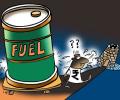
India is sending a shipment of diesel and petrol to Sri Lanka to help alleviate the country's energy crisis amidst regional instability.

The Indian government has addressed Parliament regarding a case of an Indian national seeking repatriation from Russia due to the situation in West Asia and the Gulf region. The government also responded to queries about Indian nationals denied entry to South Korea and seafarers detained in foreign countries.

India observed the first anniversary of the Pahalgam terror attack, with leaders paying homage to the victims and asserting the country's commitment to fighting terrorism.
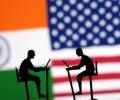
David Perdue said in a post on X that the US-India relationship delivers real results through close cooperation in diverse areas, including defence, energy and through Quad engagement.

Jaishankar said such a description would be like putting the perpetrator and the victim of the Pahalgam attack at the same level.

India has expressed condolences over the death of Iran's Supreme Leader Ayatollah Ali Khamenei following a joint US-Israel strike, amidst rising tensions in West Asia and criticism over the sinking of an Iranian warship.
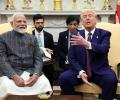
Prime Minister Narendra Modi and US President Donald Trump discussed the West Asia crisis and the importance of keeping the Strait of Hormuz open and secure. They also reviewed progress in bilateral ties and anticipated upcoming deals in the energy sector.

National Security Advisor Ajit Doval hosted Bangladesh Foreign Minister Khalilur Rahman for a dinner meeting, signalling efforts to repair bilateral ties after a period of heightened diplomatic tension.

Iran's ambassador to India, Mohammad Fathali, has described India as a "reliable and compassionate" partner while asserting Tehran's territorial authority over the Strait of Hormuz amidst ongoing regional tensions.

The meeting comes in the wake of the terrorist attack in Jammu and Kashmir's Pahalgam on Tuesday in which 26 men, mostly tourists and including a Nepalese citizen, were gunned down in cold blood.

India's handling of the Iran crisis reflects a growing strain between strategic autonomy and geopolitical alignment, observes Ambassador M K Bhadrakumar.

'Nepal today is far more aware, self-confident, aspirational, and assertive.' 'India's policy so far has not been geared to this shift. It is time to redraw our Nepal strategy.'

If Trump wants peace with Iran, Pakistan will offer to help. If Trump seeks Pakistan's aid to spy on Iran, then too Munir will not hesitate to chip in. At the same time, the ISI will not hesitate to tip off Iran now and then, points out M R Narayan Swamy.

Iran was the chance to arrange a concert of nations, to actually be a Vishwaguru. Instead, we are watching from the sidelines as Pakistan, the same country that is apparently still at war with Afghanistan, hosts talks between US-Israel and Iran. The irony is hard to miss, points out Amberish K Diwanji.

He said Prime Minister Narendra Modi has made it "very clear" that any talks with Pakistan will be only on terror.

Russia's First Deputy Prime Minister Denis Manturov met with Indian leaders to discuss strengthening bilateral ties in key sectors amidst the escalating conflict in West Asia.

Indian External Affairs Minister S Jaishankar and his Canadian counterpart Anita Anand held their first phone conversation, focusing on strengthening bilateral economic ties and advancing shared priorities. The call comes amid efforts to repair relations between the two countries, which had been strained under the previous Canadian government. Both ministers expressed their commitment to improving ties and working together on areas of mutual interest. The conversation follows a period of tensions stemming from allegations of Indian involvement in the killing of a Sikh activist on Canadian soil.

The Congress party has criticised Prime Minister Narendra Modi's diplomatic efforts following the ceasefire agreement between the US and Iran, facilitated in part by Pakistan. The party claims this development undermines Modi's strategy and exposes his perceived failures in foreign policy.

Prime Minister Narendra Modi convened a meeting with senior ministers to assess the impact of the evolving situation in West Asia on India's crude oil, gas, petroleum, power, and fertiliser sectors, focusing on ensuring uninterrupted supply and stable logistics.

There is no cause for concern, as the overall situation arising out of the crisis is firmly under control, the Centre informed while briefing political parties at the all-party meet.
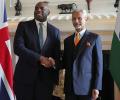
India's External Affairs Minister S Jaishankar has stated that the US administration under President Donald Trump is moving towards multipolarity, which aligns with India's interests. He also revealed that India and the US have reached an agreement on the need for a bilateral trade pact. Jaishankar touched upon various foreign policy issues including India's role in the Russia-Ukraine conflict, the trajectory of the BRICS grouping, and relations with China during a session at the Chatham House think-tank in London.

External Affairs Minister S Jaishankar has said the recent confrontation between India and Pakistan was not just a mere conflict between two neighbours, but it was about combating terrorism, which will eventually come back to haunt the West.
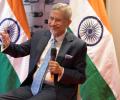
'As far as I'm concerned, how effective the Rafale was or frankly, how effective other systems were -- to me, the proof of the pudding is the destroyed and disabled airfields on the Pakistani side'

Prime Minister Narendra Modi will review the impact of the West Asia conflict on India's food, energy, and fuel security with senior cabinet ministers. The meeting follows previous discussions and concerns raised about global energy crises and supply chain disruptions.
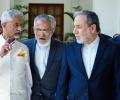
India has no intention to escalate tensions with Pakistan, but any military attacks on its soil will be met with a "very" firm response, External Affairs Minister S Jaishankar said on Thursday. Jaishankar made the remarks at a meeting with Iranian Foreign Minister Abbas Araghchi, emphasizing that the "barbaric" Pahalgam terror attack compelled India to carry out strikes on "cross-border" terror infrastructure on Wednesday. He reiterated that India's response was targeted and measured, but stressed that any further military attacks would be met with a firm response. The Iranian foreign minister, who landed in New Delhi amidst escalating tensions between India and Pakistan, called for de-escalation of the situation and stressed the need for regional cooperation to eradicate terrorism. The meeting also focused on boosting ties in areas of trade and investment, including the Chabahar port project.
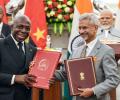
India's External Affairs Minister S Jaishankar has called on Europe to display sensitivity and mutuality of interest for deeper ties with India, stating that New Delhi seeks partners, not "preachers." Jaishankar emphasized the importance of "Russia realism" in India's foreign policy, highlighting the natural complementarity between India and Russia as a resource provider and consumer. He criticized attempts by the West to address the Russia-Ukraine conflict without Russia's involvement, arguing it "challenged the basics of realism." Jaishankar also stressed the importance of finding common ground with the US, suggesting that focusing on mutuality of interest rather than ideological differences is key to successful engagement.
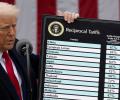
The impact of United States President Donald Trump's reciprocal tariffs is not yet known and New Delhi's strategy to deal with the situation is to firm up a bilateral trade pact with Washington, DC by fall of this year, External Affairs Minister S Jaishankar said on Wednesday.

External Affairs Minister S Jaishankar said the 2008 Mumbai terror attack marked a turning point in relations with Pakistan when Indians collectively felt that such behaviour from a neighbouring country could no longer be tolerated. Speaking at Charotar University of Science and Technology, Jaishankar acknowledged India's transformation under Prime Minister Narendra Modi over the last decade, while Pakistan has remained unchanged, continuing with what he termed as its "bad habits."

The Indian government has convened an all-party meeting to discuss the ongoing crisis in West Asia, following Prime Minister Modi's address to Parliament on the situation and its potential impact on India.
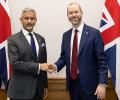
The UK has strongly condemned a security breach involving a pro-Khalistan extremist rushing towards External Affairs Minister S Jaishankar's convoy in London. The incident took place as Jaishankar was leaving the Chatham House think tank on Wednesday evening. The protester was swiftly taken aside by officers of the Metropolitan Police, with no arrests being confirmed so far. The UK said such attempts to "intimidate, threaten, or disrupt" public events are "completely unacceptable". The incident comes after Jaishankar's talks with UK Foreign Secretary David Lammy, during which both leaders covered the entire gamut of bilateral ties, including the relaunched Free Trade Agreement (FTA) negotiations, regional and global issues. The MEA has condemned the security breach and the provocative activities of the "small group of separatists and extremists", calling on the UK to "live up to their diplomatic obligations".

The US President had hosted Modi for an official working visit in Washington, DC, on February 13 last year.
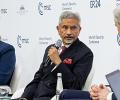
India's External Affairs Minister S Jaishankar countered a US senator's claim that democracy does not put food on the table, citing India's PMGKAY program which provides food to 800 million people. Jaishankar argued that different parts of the world have different experiences with democracy and that the model of globalization has contributed to issues with democracy in some regions. He emphasized that India's democratic system effectively delivers food security, highlighting the PMGKAY program as an example.

Prime Minister Narendra Modi convened the Cabinet Committee on Security to address the impact of the West Asia conflict on Indian citizens, focusing on safeguarding them from the conflict's effects and ensuring the smooth flow of essential supplies.

Prime Minister Narendra Modi stayed calm, avoided public confrontation, and focused on India's long-term interests to steady ties with the United States.

As Iran heads into crucial peace talks with the United States of America, here are the six men who decide the Islamic Republic's course.
US Secretary of State Marco Rubio spoke separately with External Affairs Minister S Jaishankar and Pakistani Deputy Prime Minister and Foreign Minister Ishaq Dar, State Department Spokesperson Tammy Bruce said in a statement early Saturday.

'The West Asia or the Gulf crisis has shown that what we develop as national infrastructure when things are not as bad as they could be, we forget to plan for adversities.'
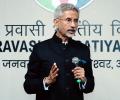
External Affairs Minister S Jaishankar will represent India at the inauguration of Donald Trump as the 47th President of the United States on January 20.
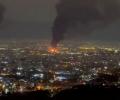
To be sure, Trump is furious, as the trajectory of the war is in a state of Zugzwang, as chess players call it. Trump and Netanyahu stare at two choices -- retreat in humiliation and concede Tehran's demands -- recognition of its rights, reparations, and binding security guarantees -- or perish in a quagmire, points out Ambassador M K Bhadrakumar.
